
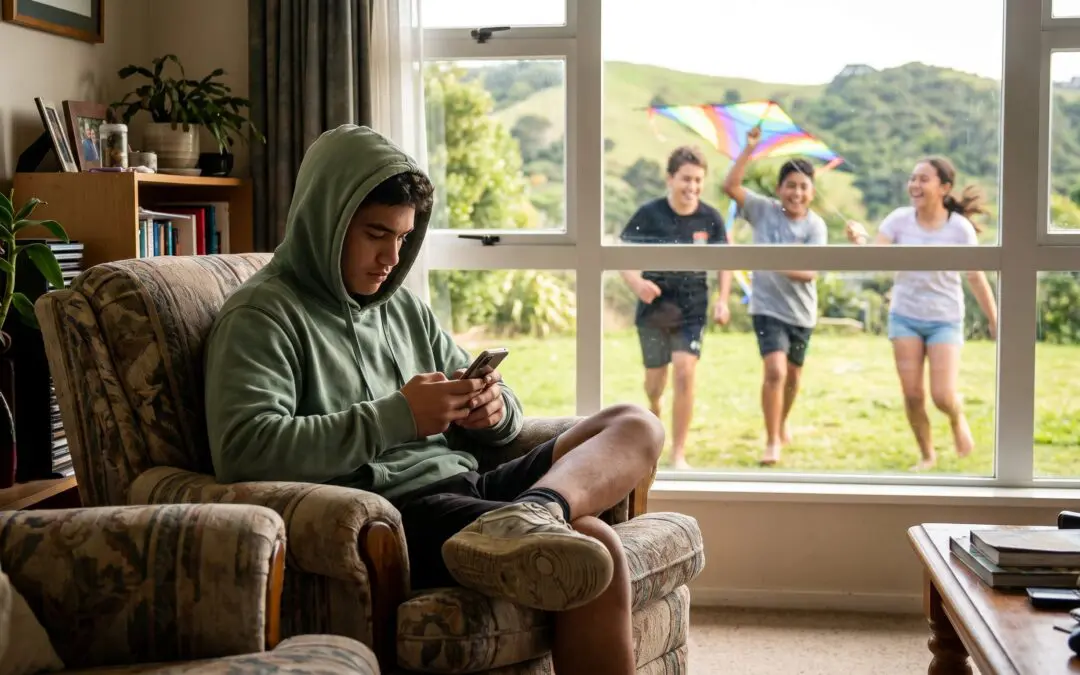
Over the past decade, something significant has changed.
Psychologist Jonathan Haidt, author of The Anxious Generation, points to a major shift that took place in the early 2010s. Blackberry’s and dumb phones went out the door, and smartphones became widespread.
Front-facing cameras arrived, and social media platforms like Instagram and Facebook took off and forever changed the way our tamariki socialise and spent their time.
Since then, research across countries similar to Aotearoa (UK, CA, USA, AU) has shown significant rises in anxiety, depression, self-harm, and loneliness among young people.
Parents and teachers across Aotearoa are noticing it too: more anxiety, less resilience, lower confidence and more social struggles. Our youth are spending more time online, less time outside.
Staffroom and parent conversations constantly touch on it too: “Gee, this year we’ve noticed students really struggling with challenges and change.” and ”Hey, have you noticed a lack of resilience in this group?”
But when you step back, this isn’t just a one-off observation. For many people, it feels like it’s snowballing year after year.
Young people today are more digitally connected than ever before… yet many are increasingly disconnected from our day-to-day world, from each other, and sometimes even from themselves.
Haidt’s core idea is pretty simple: Childhood has shifted from being play-based to phone-based.
What has changed?
Previous generations spent huge amounts of time outside: exploring, biking, climbing trees, making up games, getting bored, solving problems, and learning independence naturally.
I remember spending all day at the local creek, catching and releasing eels. Going cycling with mates all day, riding through town, exploring, getting lost (No Google Maps!) and walking home with a ‘flatty’.
Today, many young people spend much of their free time scrolling, gaming, messaging, consuming content, and comparing themselves online. As adults, we’ll often catch ourselves going down this rabbit hole too.
Haidt argues that this shift has robbed young people of the “biological necessity” of real-world experience, which is where resilience and social capability are built.
At the William Pike Challenge (WPC), we are concerned that a “phone-based childhood” is being accepted as the new norm. We worry about the long-term impact this will have on the confidence and independence of an entire generation.
Confidence is built through ‘doing hard things’
One of the key messages from The Anxious Generation is that confidence doesn’t come from comfort.
Young people need specific experiences to build resilience by trying new things, facing challenges, navigating setbacks, solving problems, and discovering they can handle discomfort. That’s how real confidence is formed.
We see this all the time at the WPC. Young people’s confidence is formed when they have a hmmm and realise: “I didn’t think I could do that… but I did.”
Here are three examples we have seen, of the benefits students gain when trying new things:
“Before doing William Pike I was scared to talk to anyone I didn’t know. I would rehearse conversations in my head, but even then I was too anxious to talk. After helping out at the library each week, I slowly became more confident talking to anyone. This has helped me so much, especially as I am going to high school next year.”
Student A, Rangiora Borough School“Ever since I did the William Pike Challenge, I’ve unlocked new hobbies such as cooking, baking, biking and more. Those were hobbies I’d never expect myself to connect with. When you find new hobbies, you unlock new things to do rather than it just being a device.”
Student B, Clearview Primary School“Before the William Pike Challenge I spent Tuesdays just watching YouTube, but now after school I go to St Andrews Retirement Village and play chess with one of the residents.”
Student C, Sacred Heart College
Most of us adults can probably relate to this too. Some of the experiences that shaped us most were the ones that challenged us.
Who remembers walking to school every day? Riding to the dairy to buy pick ’n’ mix lollies? Heading off on an adventure with friends and not coming home until dinner time?
These might seem like little things. But they were a big deal and they built confidence.
Why this matters today in New Zealand
New Zealand has traditionally had a strong culture of outdoor adventure, independence, practical learning, community, and the classic ‘Number 8 wire’ mentality.
But childhood is changing rapidly. Parents and educators are now noticing young people who are less willing to fail, less confident socially, and more dependent on devices for entertainment and connection.
This doesn’t mean young people are weak, or that parents and teachers are bad, it means the environment they are growing up in has changed dramatically. And environments shape behaviour.
The good news and practical solutions
The encouraging part is that many of the solutions aren’t rocket science. They’re surprisingly human and pretty simple.
Some ideas that could work in the classroom include:
- creating outdoor experiences – take science or maths to the local park
- embracing group work – across learning areas and encourage collaboration
- encouraging responsibility – assign student responsibilities and hold them to account
- promoting physical activity – never skip fitness and P.E
- creating challenging opportunities and experiences – push students slightly outside of their comfort zones
- fostering independence – design tasks students must navigate entirely on their own
- involving the community – connect learning to local people and places
This conversation is just beginning
This isn’t about banning phones or blaming young people. It’s about asking an important question: What kinds of experiences and initiatives help young people truly thrive?
Over the next few blogs, we’ll explore ideas like:
- Anti-fragility and why challenge matters
- Independence and confidence
- Real-world connection vs digital connection
- Why contribution gives young people purpose
- The power of outdoor adventure
- What parents and schools can practically do
Because raising resilient young people in today’s world may require us to rethink our preconceived ideas, and what childhood and school experiences should look like, so that we can unlock their confidence for the future.
Recent Comments