
Getting outside the classroom is one of the most rewarding parts of teaching in Aotearoa New Zealand. Whether you are leading a field trip to the local rocky shore, taking a kapa haka group to a regional competition, or running programmes like the William Pike Challenge, real-world learning leaves a lasting impact on our ākonga.
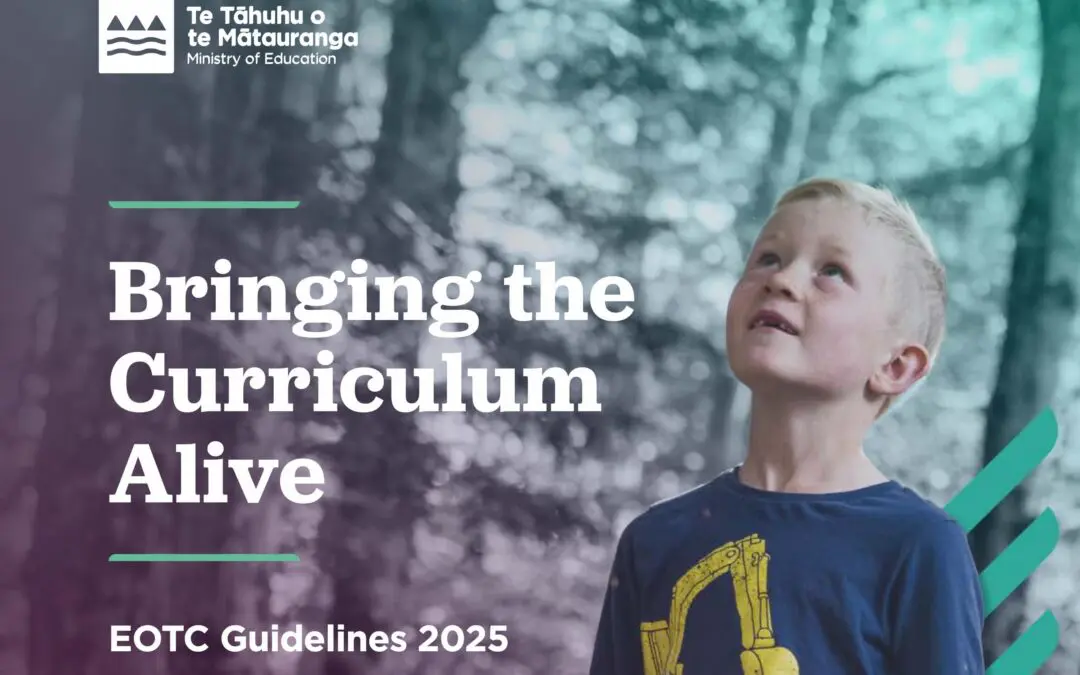
However, there are some changes you should know about since the Ministry of Education officially updated its guidelines, releasing ‘Bringing the Curriculum Alive: EOTC Guidelines 2025’.
If your school’s EOTC safety management system has not been reviewed recently, there may be outdated terminology or processes that no longer reflect current good practice. To avoid this sticky situation, read on!
This blog breaks down exactly what has changed under the updated guidelines in plain language and highlights legal requirements.
1. Goodbye ‘RAMS’ and hello to the RAS
For decades, New Zealand teachers have associated trip paperwork with one acronym: RAMS (Risk Analysis Management System).
The change – RAMS forms and SAPs (Safety Action Plans) are officially out-of-date and are no longer recognised as current good practice. Risk Assessment and Supervision (RAS) Forms are the new tool for detailed risk assessment, controls, leadership and supervision plannin
What you need to know
The updated system utilises an EOTC Safety Management Plan (SMP) accompanied by an EOTC Toolkit, which can be sourced via Education Outdoors New Zealand (EONZ):
* EOTC Safety Management Plan (SMP): School leaders have reported to us that the SMP is the document each school should get right first, as doing so helps the school determine which templates from the EOTC Toolkit they need to use for each EOTC activity.
* EOTC Toolkit: The EOTC Toolkit has everything you need (and more). It includes a large number of templates to support schools in EOTC planning, implementation, and review. Not all templates need to be used for every EOTC activity, and completing your SMP will inform you which templates should be used. [Note: you need to scroll down the page a bit to get to the individual templates].
* Risk Assessment and Supervision form (Note: Not every event requires a new RAS. For recurring activities, an appropriate SOP can provide a more efficient way of documenting established risk management and supervision arrangements)
2. A streamlined workflow: The 4-Stage EOTC cycle
The old management cycle featured an administrative five-stage process. The updated guidelines condense this into a four-stage management cycle designed to keep planning and documentation proportional to the actual level of risk.
Stage 1: Proposal (School sign-off)
Before doing any heavy lifting, you must get the green light. Approval expectations scale with the type of activity:
* Low Risk: Routine activities in local environments during school hours generally require approval from a delegated team leader or EOTC coordinator.
* Medium to High Risk / Overnight: Adventure activities or multi-day camps are likely to require joint approval from your EOTC Coordinator and the Principal/Senior Leadership Team, and depending on your specific school policy, approval from the school board. Note: current good practice is for ‘approval’ to sit with the principal or their delegates and ‘assurance’ is the board’s role.
Stage 2: Planning and preparation
This is where you gather your digital toolkit.
* Confirm that relevant information about ākonga is current and available (EONZ Form 9. EOTC Ākonga Health Profile can be used for this).
* Check that leaders and supervisors are competent for their assigned roles, confirm transport arrangements, and ensure emergency procedures are appropriate for the event.
* Important: A pre-activity briefing should take place for all staff, assistants and volunteers to confirm understanding of roles and communication and emergency arrangements and to highlight any significant risks to be monitored.
Stage 3: Implementation
Paperwork doesn’t manage a live scene; active critical thinking does. Kaiako must constantly look through a risk assessment lens as environmental conditions change. Schools should now establish hard operational limits where changing conditions can materially affect safety, identify operational limits and decision points in advance, such as weather, river, surf or other environmental thresholds. During the event, competent staff continue to assess changing conditions and modify, postpone or stop an activity when risks can no longer be adequately managed.
Stage 4: Post-event review and evaluation
The loop closes when you get home. Every EOTC event should be reflected on/reviewed, but that does not mean every event requires a formal review. EONZ suggests Form 18 Event Review should be used for significant and/or complex events such as multi-day, high-risk or multiple-class events or following an incident. Routine, smaller or lower-risk events can use a much simpler review process.
3. Supervision overhaul: Fixed ratios are out
If your school policy states that all trips must strictly adhere to a blind 1:8 or 1:10 ratio regardless of the location, your policy is officially out-of-date.
The change – The Ministry of Education has explicitly stated that set or prescribed ratios are no longer considered good practice in educational settings. Rigid numbers are simply too simplistic to guarantee student safety.
What to do instead:
Supervision structures must be calculated dynamically on a case-by-case basis during your risk assessment by weighing up several moving parts including:
*The actual physical, developmental, behavioural, and medical needs of your ākonga.
* The technical competence of your supervisors and volunteers (e.g., a qualified instructor vs. an enthusiastic parent helper).
* The environment, season, and weather forecast (e.g., trip to a local park vs. trip to the beach, or flat water vs. grade 2 moving water).
The ‘PIC Overview’ Rule
For large groups or complex outdoor camps, the Person in Charge (PIC) should remain completely free from directly supervising a specific group of students. This ensures the lead teacher is free to maintain a global safety overview and immediately co-ordinate an emergency, first aid, or media response if an incident occurs.
4. Total inclusivity under NZ law
Schools have primary statutory obligations under the Education and Training Act 2020 and the Health and Safety at Work Act 2015 to provide physically and emotionally safe environments. The change – the updated guidelines place emphasis on proactive diversity and inclusive design.
Real-world application
Schools should plan proactively for equitable participation and make reasonable adjustments to support the needs of individual ākonga. Decisions about participation should be individualised and made in consultation with the ākonga, whānau and, where appropriate, relevant specialists. Where a significant risk cannot be adequately managed, schools should consider alternative ways of enabling meaningful participation and equivalent learning opportunities.
When mapping out an outdoor module, kaiako should design robust Individual Ākonga Support Plans. This includes vetting venues for all-gender bathrooms, ensuring private changing spaces, and confirming appropriate, supportive sleeping arrangements on overnight trips.
5. Who needs a safety check? Staff vs. volunteers
When organising parent helpers or contracting external companies for your trips, understanding the Children’s Act 2014 boundaries is essential.
* Paid workers: Whether a person requires a full Children’s Act safety check depends on whether they meet the definition of a children’s worker. Where the school directly employs or engages a children’s worker, the school must ensure the required safety check has been completed before they begin. Where a children’s worker is employed or contracted by an external organisation (like school camp providers), the school should confirm that the employing organisation has completed the required safety check. A full safety check includes Police vetting as one part of the process.”
* Adult volunteers (Legally exempt): Parents or caregivers who volunteer to support a school camp, drive private vehicles, or billet students in their homes without payment are not required to be formally safety-checked under the Children’s Act 2014, or police vetted under the Education and Training Act 2020.
* The catch: While volunteers are legally exempt from the Act, child protection must come first. Your school’s policy should clearly state the school’s position on safety/ police checks.
6. School-Led EOTC vs. Parent-Led activities
Programmes like the William Pike Challenge empower kids to grow through a mix of school-organised outdoor activities, community service, and passion projects. The updated guidelines outline the responsibilities of the school and parents
School-Led activities
If an activity is organised, led, or supervised by school staff (such as a teacher-led class trip to a regional park), the School Board acts as the Person Conducting a Business or Undertaking (PCBU) and holds primary duty of care and legal liability. You must execute the full planning, risk tracking, and approval cycle.
Parent-Led / At-Home Activities
Where an activity is genuinely parent-led and is not organised, directed or supervised by the school, the parent or caregiver takes responsibility for supervision and day-to-day safety decisions. Schools should clearly communicate the respective responsibilities of the school and whānau
To ensure clarity, it is vital to communicate this distinction clearly to whānau in writing at the start of the programme.
Take action today:
- Check your systems: Work with your school’s designated EOTC co-ordinator to ensure you have a current Safety Management Plan and are utilising current EONZ templates.
- Register with the National EOTC Coordinator Network: Ensure your school’s EOTC leader is registered with the National EOTC Coordinator Network for real-time safety updates.
- Take an EONZ course: EONZ courses are great because they empower educators to confidently deliver safe, hands-on, curriculum-linked learning beyond the traditional classroom. They provide practical skills in risk management and deepen your ability to connect students with local environments.
- Get gold standard support: here at the William Pike Challenge, we work with many schools that are highly experienced in delivering EOTC and are happy to share what they have done around the new guidelines. Get in touch with us, and we can connect you with one of these schools for support.
Recent Comments